A client called me in after 18 months of CMDB implementation.
The project was „done.” The budget was spent. The team was exhausted.
And the CIO still couldn’t answer one question:
„What services do we actually run?”
Here’s what I found when I looked under the hood:
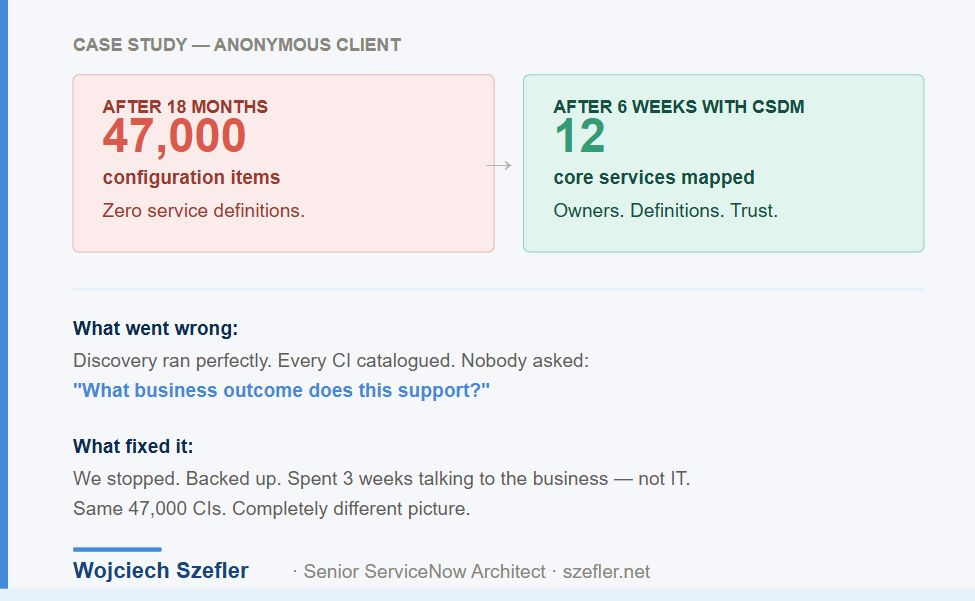
47,000 configuration items in the CMDB. Zero service definitions.
They had built a perfect inventory of assets. And called it a service model.
It’s not the same thing.
The discovery tool had run beautifully. Every server, every application, every network device — catalogued, classified, linked.
But nobody had ever asked: what business outcome does this support?
So we stopped. Backed up. And spent 3 weeks doing something the original project skipped entirely:
Talking to the business.
Not IT. The business.
We mapped 12 core services. Found owners for each one. Defined what „healthy” looked like from a business perspective — not a technical one.
Then we rebuilt the service model on top of the existing data.
Same 47,000 CIs. Completely different picture.
Six weeks later, the CIO had her answer. And the team had something they’d never had before: a CMDB they actually trusted.
The tool was never the problem. It never is.
This case study is real. I’ve changed the details, but the situation? I’ve walked into it more than once.
The client wasn’t incompetent. The team wasn’t lazy. They just started with the tool instead of the model.
That’s the most common and the most expensive mistake in ServiceNow implementations.
If you’re running a CMDB or CSDM initiative right now — or about to start one — and this story sounds familiar, let’s talk before your next refresh.